

Cataract is a clouding of the lens of the eye, which is clear in normal conditions. This clouding weakens vision, and its degree and pattern within the lens of the eye may differ from one person to another. Here in Dr. Hala Wahba centers, the best doctor for cataract treatment in Egypt, we have more than 20 years of experience in the field of cataracts and vision correction.
How is cataract diagnosed?
The first person to feel the cataract is the patient himself, as he begins to feel difficulty in clear vision, such as not being able to read the road crossing or write the television that he used to see before, and sometimes it is more dark and dazzling in the light of day
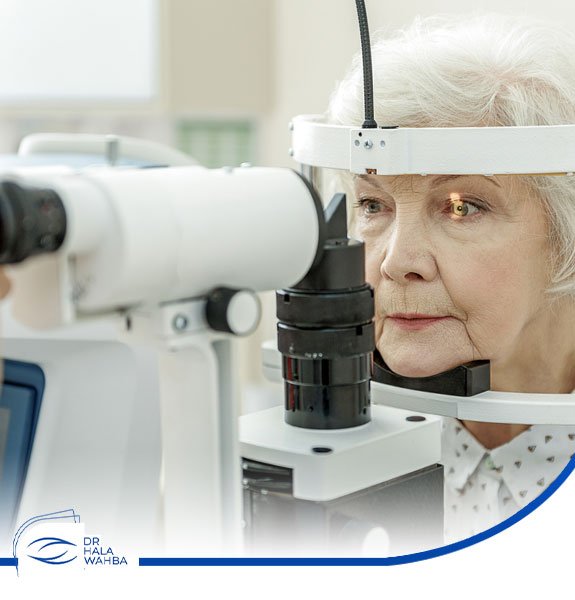
As for Dr. Khalil, as an ophthalmologist, he detects with several devices, including the slit lamp, which shows very accurately the degree and type of cataracts present.
What are the symptoms of white water?
• Blurry, blurred or dim vision
• Slight sensitivity to light or glare (especially to car lights when driving at night)
• The need to change glasses (sudden nearsightedness)
• Double vision in one eye
• The need for stronger light when reading
• Poor vision at night
• A change in the way you see colors, especially yellow
What are the causes of white water?
The eye is very similar to a camera. Light rays enter through the front of the eye, pass through the cornea, pupil, and aqueous humor (i.e., the colorless fluid at the front of the eye) to reach the lens of the eye. The lens refracts light rays to focus objects on the retina at the back of the eye. Next, the retina, optic nerve, and brain process the images until vision is formed.
Cataract disease results from the accumulation of proteins in the lens of the eye. These proteins cloud the lens and prevent light from passing through it, resulting in some loss of vision.
This disease may also result from:
• Genetic (ie hereditary) disorders
• Health problems such as diabetes
• Taking certain medications.
Eye injury or injury
Other factors that may exacerbate cataracts include smoking, air pollution, and excessive alcohol consumption.
Basics of cataract surgery
In cataract surgery, the defective lens from inside the eye, which has become cloudy, is removed and replaced with an artificial lens (called an intraocular lens or IOL) to restore clear vision. This procedure is usually done in an outpatient setting and does not require a stay of more than one night.
Most cataract procedures involve the use of a high-frequency ultrasound machine, which breaks up the cloudy lens into small pieces, which are then gently removed from the eye by suction.
This procedure, called phacoemulsification, can be performed with smaller incisions than previous cataract surgical techniques, promoting faster healing and reducing the risk of cataract surgery complications, such as retinal detachment.
After all remnants of the cloudy lens have been removed from the eye, the surgeon inserts an artificial lens into the eye, locating it securely behind the iris, in the same location that the natural lens would have occupied, (in special cases, the IOL may be placed in front of the iris, but this is less common).
Next, the surgeon completes the cataract operation by closing the eye incision (a stitch may be needed), and a protective shield is placed over the eye to keep it secure during the recovery phase of the operation.
When should the surgery be performed?
Surgery should be resorted to when cataracts lead to a significant loss of vision that affects the patient’s daily important activities, such as reading, driving, or recreational activities such as golf or tennis. Sometimes, cataract surgery is necessary to evaluate and treat other eye conditions, such as changes in the retina caused by age or diabetes. In these cases, the ophthalmologist can help the patient make the appropriate decision.
How is cataract surgery performed?
Cataract surgery is performed on an outpatient basis under local anaesthesia. During surgery, the cloudy lens of the eye is broken up using high-frequency sound waves or ultrasound, and then it is suctioned out of the eye with a process called phacoemulsification or phacoemulsification. The cloudy lens is replaced with a clear plastic lens chosen to fit the patient’s eye and implanted inside the eye so that the patient can restore his ability to normal vision. It is also possible in surgeries for a type of laser that depends on sending very fast flashes within a very short period (ie, one millionth of a billionth of a second), and this may lead to more accurate results.
When does vision improve after surgery?
Most patients’ ability to see in the operated eye improves after about a week. The patient may still need to wear eyeglasses after surgery for a short period.
Is cataract surgery safe?
About 98 percent of cataract surgeries are performed annually without serious complications. Nevertheless, it is recommended to consult an ophthalmologist about the potential risks.
How successful is cataract surgery with lens implant?
Cataract surgery with lens implant is one of the most common surgeries patients undergo, with more than 1.5 million surgeries performed every year. Also, more than nine out of 10 people who underwent cataract surgery had excellent vision recovery.
Are there dangers of leaving cataracts without operation?
Leaving the cataracts may lead to complications such as high intraocular pressure or disintegration of the circular ligament that holds the lens in place, which leads to its fall into the fundus of the eye. This happens to some people who suffer from cataracts in one eye and are late in removing it surgically because they can see in the eye